Allergen Information on a Printed Menu: What UK Law Actually Requires
Yes, UK law requires allergen information on a menu, in one form or another. What isn't settled anywhere else is how that information should actually sit on a printed page. Page one on Google for allergen queries belongs to gov.uk, Allergy UK and Trading Standards, and that is where the law itself should stay. I print menus for a living, so this piece covers the part they leave out: what putting allergens on paper does to your layout, your page count and your print bill.
What are the food allergy laws for restaurants in the UK?
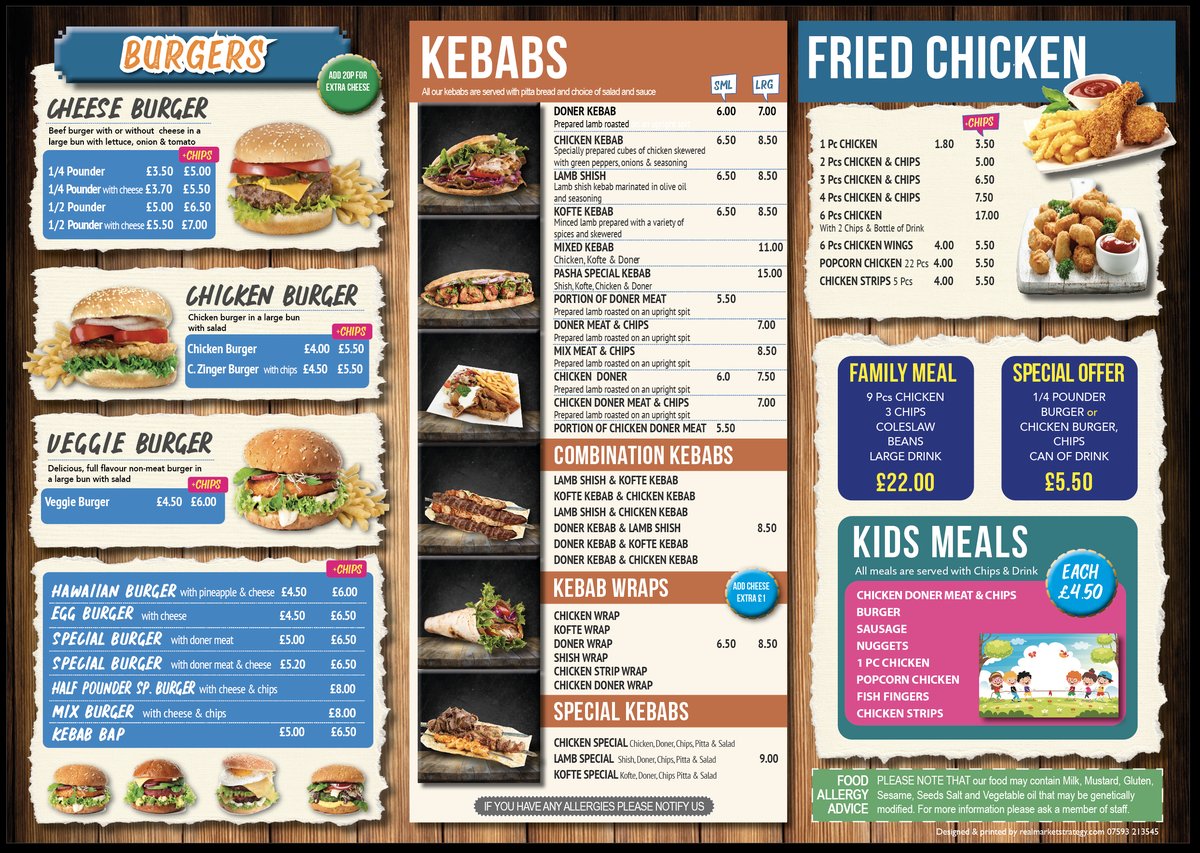
Two rules apply, and which one covers you depends on how the food is sold. Prepacked for direct sale food, meaning something wrapped on site before a customer orders it, such as a sandwich made that morning and put in the chiller, falls under Natasha's Law. The Food Information (Amendment) (England) Regulations 2019 took effect on 1 October 2021 and require a full ingredient list on the pack, with the 14 allergens emphasised, usually in bold. For food cooked to order and served on a plate, which covers most takeaway and restaurant menus, the rule is different: allergen information has to be available, and the customer has to be signposted to where it is.
A QR code pointing to an allergen page online is acceptable, but only where a printed or spoken alternative sits next to it too. This article is not legal advice. The current rules, and any changes to them, sit with the Food Standards Agency at food.gov.uk, and your local authority environmental health team can confirm how they apply to your kitchen.
What are the 14 allergens UK?
The Food Standards Agency names 14 allergens that a food business must declare when they are present in a dish, drink or ingredient.
- Celery
- Cereals containing gluten (wheat, rye, barley, oats)
- Crustaceans (prawns, crabs, lobster)
- Eggs
- Fish
- Lupin
- Milk
- Molluscs (mussels, oysters)
- Mustard
- Peanuts
- Sesame
- Soybeans
- Sulphur dioxide and sulphites (above 10 parts per million)
- Tree nuts (almonds, hazelnuts, walnuts, pecans)
Every one of these has to be named if you use the bold-note or matrix layout below. A general phrase such as "may contain nuts" does not meet the requirement on its own. The customer needs to know which of the 14 is actually in the dish in front of them.
How do you write allergens on a menu?
Three layouts do the job on a printed menu: a bold note against each dish, a matrix grid, or a signpost line to a separate sheet. Each one trades legibility, page size and reprint cost differently, and the right choice depends on how often your menu changes.
Bold note per dish. Add the allergens in bold straight after the dish description, for example "(contains gluten, egg, sesame)". Nothing extra to design or print, and the information sits exactly where the customer is reading. The cost shows up in density. A menu with eight or ten dishes, each carrying three or four allergens in bold, fills up fast, and once you shrink the type to make it fit, the bold text is the first thing that stops being legible.
Matrix grid. A table with dishes down the side and the 14 allergens across the top, ticked box by box, gives a customer a complete answer for every dish at a glance. Fourteen columns plus a dish name column does not fit on an A5 page or an upright A4 page at a size anyone can read without a torch. That is a real printing consequence: a matrix belongs on A3 or a landscape A4, and the extra width is the trade-off for the extra completeness.
Signpost sheet. Keep the main menu clean with one line, "Ask a member of staff for allergen information", and hold the detail on a separate A5 sheet at the counter. This is the layout that survives a recipe change without a full menu reprint, because you reprint one flat sheet, not the whole run.
| Layout | Typical page size | Print price example | What a recipe change costs |
|---|---|---|---|
| Bold note per dish | A5 or A4, no size change | Part of the main menu run | Reprint the whole menu |
| Matrix grid | A3 or landscape A4 | A3 bi-fold, 6 pages, 1,000 at £228.32 | Reprint the whole menu |
| Signpost sheet | A5 flat, kept separate | A5 flat, 1,000 at £89.32, 8.9p each | Reprint the A5 sheet only |
Prices correct as of September 2026.
Keep bold allergen text at 8 point minimum on any layout, and closer to 9 or 10 point if the venue serves an older customer base or the lighting at the table is low. Below that, bold weight stops adding contrast and just adds ink. A matrix grid needs the same discipline in every box, because a tick or a dash that isn't clearly one or the other is worse than no matrix at all.
What happens to your allergen information when you change a supplier?
It goes out of date, and it is your job to catch it before someone orders the dish. Swap a spice mix, a stock cube or a bought-in sauce and you can add or remove an allergen without ever changing the dish's name on the menu. The Foodservice Price Index, run by Prestige Purchasing with NielsenIQ on 10.7 million transactions a month, rose to 150.4 in March 2026 and then jumped 1.8% in a single month in June 2026, the largest move of the year. Shaun Allen, Prestige Purchasing's CEO, put it plainly on 24 July 2026:
"The 1.8% month-on-month spike is a stark reminder of how fragile the food supply chain remains."
A fragile supply chain means substitutions, and substitutions mean your allergen information needs checking more often than most owners plan for. This is the real argument for the shorter print run on your main menu and a separate, cheap sheet for allergens: you update the part that actually changes without touching the part that doesn't.
Signposting verbally still needs a member of staff trained to get it right under pressure. From 1 April 2026 the National Living Wage rose from £12.21 to £12.71 an hour, up 4.1% (gov.uk), so that training time is not free either. A printed sheet does the same job without relying on anyone's memory on a busy Friday night. The full range of formats and quantities, including the folded options for a bigger main menu, is on the menu printing price list.
Frequently asked questions
Is there a 14 allergens list PDF I can print?
The Food Standards Agency publishes a free poster and template listing all 14 allergens on food.gov.uk, and it is designed to be printed and displayed. Use it as a reference for wording, then build your own bold notes, matrix or signpost sheet from it so the allergens match your actual dishes.
Do I need an allergy menu app?
No app is required by law. Some restaurants use one alongside a printed menu, particularly chains with frequently changing dishes, but a small independent can meet the requirement with a clearly worded printed menu and a signpost line, backed by a member of staff who knows where the detail sits.
Does food.gov.uk have an allergy menu template?
Yes, the Food Standards Agency's site hosts downloadable allergen guidance and a 14 allergens reference you can adapt into your own menu wording. It is a starting point for content, not a print-ready menu, so you still need to lay it out to fit your chosen page size.
What if a dish has no ingredients list to check against?
For food made in your own kitchen, there usually isn't a packaged ingredients list to read from. Build the allergen record from your recipe and every bought-in component, including sauces, stock and garnishes, and update it the moment any one of those changes.
Is a QR code enough on its own?
No. A QR code linking to allergen information is fine as one option, but UK guidance is clear that it needs a non-digital alternative alongside it, such as a printed sheet or a member of staff who can answer the same question for a customer without a smartphone or signal.
Read next
- What menu printing actually costs in the UK
- A4, A5 or A3: which menu size to print
- How to send artwork that prints properly
See all menu printing guides, or send me a WhatsApp on 07883 297 737 and I will price your own quantity.
